













 |
|
 |
|
|
|
| A Healthy Increase in the Number of Blacks in Academic Nursing African Americans have made tremendous strides in increasing their enrollments in academic nursing programs nationwide over the past 10 years. But at some of the nation's leading nursing schools, the black presence is still very small.
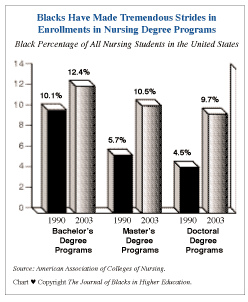
Over the past decade JBHE has examined the status of African Americans in a wide variety of academic disciplines. In many cases we were obliged to report disappointing news on the progress blacks have made in particular academic fields. Although many academics look down on nursing as a professional career, we are nevertheless pleased to report that blacks have made tremendous strides in nursing education. In 1990 there were 8,745 African Americans enrolled in bachelor's degree programs in nursing in the United States. They made up 10.1 percent of all nursing students in the nation that year. In 2003 the number of blacks in bachelor's degree programs in nursing reached a total of 14,616. This is an increase of 67 percent over the 12-year period. In 2003 blacks were 12.4 percent of all nursing school students. The progress has been even more spectacular at the graduate
level. In 1990 there were 1,197 blacks enrolled in master's degree
programs in nursing in the United States. They made up 5.7 percent
of all students in master's degree programs in nursing. By 2003
the number of blacks in these graduate nursing programs had more
than tripled to 3,635. At that time blacks made up 10.5 percent of
all students in master's degree programs in nursing.
Blacks in doctoral programs in nursing have also made tremendous progress since 1990. That year, there were 109 black students pursuing a doctorate in nursing. They made up 4.5 percent of all students enrolled in doctoral programs in the field. By 2003 the number of blacks in nursing doctoral programs had more than doubled to 264. Blacks were then 9.7 percent of all students enrolled in doctoral programs in nursing. Doctoral programs often take many years to complete and students who start a degree program do not always finish. Financial obligations often get in the way of completing a doctoral degree. Blacks, who are more likely to come from low-income families, have a greater likelihood of not completing their doctoral training. The latest figures on doctoral degrees awarded show that in 2003, 25, or 6.1 percent, of all 411 doctoral degrees awarded in the field of nursing went to African Americans. Thus, whereas blacks are nearly 10 percent of all students enrolled in doctoral degree programs in nursing, they make up just over 6 percent of all doctorates awarded in the field. Nevertheless, the increased number of black students enrolled
in graduate nursing programs is encouraging because it
undoubtedly will lead to a greater number of black faculty
teaching in the field. The American Association of Colleges of
Nursing reports that blacks now make up 5.4 percent of all faculty
at its 575-member nursing schools. This is a slightly higher
percentage than that of all black faculty in all disciplines at
American colleges and universities. However, a large number of the
black faculty members in nursing may be teaching at the 23 nursing
schools at historically black colleges and universities.
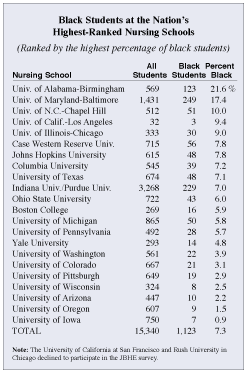
Blacks at the Nation's Before we conclude our analysis of blacks in academic nursing, it is important to note the level of black enrollments and faculty at the nation's highest-ranked schools of nursing. It is students from these schools who will more likely go on to graduate study in nursing and become the leaders of the profession in the years to come. JBHE surveyed the nation's 25 highest academically ranked nursing schools to determine the number and percentage of black students at each school. At the 22 top-ranked nursing schools that responded to our survey, there were 1,123 black students. They made up more than 7.3 percent of all students at these nursing schools. The fact that blacks make up such a large percentage of all students at these top schools is very good news. At three of the nation's highest-ranked nursing schools, blacks were 10 percent or more of all enrollments. At the University of Alabama at Birmingham, blacks were more than 21 percent of all students. There are 249 black students in the nursing school at the University of Maryland Baltimore County. They make up more than 17 percent of all enrollments. Through scholarships and mentoring programs, University of Maryland Baltimore County president Freeman A. Hrabowski III has made a concerted effort to increase the number of black students pursuing undergraduate and graduate study in the natural and health sciences. There are seven high-ranking nursing schools at which
blacks are less than 4 percent of all enrollments. They are the
University of Washington, the University of Colorado, the
University of Pittsburgh, the University of Wisconsin, the
University of Arizona, the University of Oregon, and the
University of Iowa. At all of these nursing schools, with the
possible exception of the University of Pittsburgh,
African-American enrollments are hindered by a small black
population in the surrounding area.
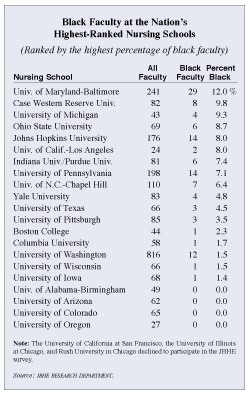
Black Faculty at the Nation's JBHE also asked the nation's leading nursing schools to divulge information on the racial makeup of their faculties. Of the 21 schools responding to our survey, there are 2,513 faculty members of all races. There are 116 black faculty members at these schools. They make up 4.6 percent of the total faculty. Surprisingly, the University of Alabama at Birmingham, which has the highest percentage of black students of any of the top-ranked nursing schools, has no black faculty members. The University of Maryland Baltimore County has the most black faculty members with 29. Blacks are 12 percent of the total faculty at the university, the highest percentage in our survey. African Americans make up at least 8 percent of the total faculty at the nursing schools at Case Western Reserve University, the University of Michigan, Ohio State University, Johns Hopkins University, and the University of California at Los Angeles. In addition to the University of Alabama at Birmingham, there are no blacks on the nursing school faculty at the University of Arizona, the University of Colorado, or the University of Oregon. | |
|
|