

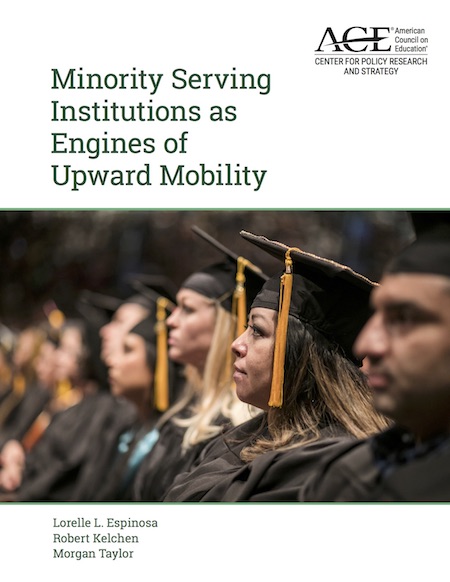
 A new report from the American Council on Education finds that the nation’s historically Black colleges and universities as well as other minority serving institutions of higher education “play an integral role in the education of students from low-income families and communities of color where educational attainment is disproportionately low and income mobility can be stagnant.”
The report found that nearly one of every four students enrolled at HBCUs and other predominantly Black educational institutions were from families in the lowest income quintile. This is more than three times the rate for non-minority serving institutions. Yet some 20 percent of graduates of HBCUs moved from the lowest two income quintiles to the top two income quintiles. This is more than double the rate of non-minority serving institutions.
The report notes that graduate of these institutions are achieving upward economic mobility despite the fact that many of these colleges and universities operate on limited budgets and do not have the educational resources offered by non-minority serving institutions.
The report concludes that “these institutions are standouts in the field for their contribution to income mobility even while they are operating with limited resources. One sees a strong case here for increased investment in institutions that are meeting students where they are, and making good on the value of higher education for individuals, families, and communities.”
The full report, Minority Serving Institutions as Engines of Upward Mobility, may be downloaded by clicking here.