

JBHE has compiled a listing of Black student graduation rates at a large group of the nation’s historically Black colleges and universities. The graduation rates shown here are four-year averages for Black students who entered a particular college or university from 2001 to 2004 and earned their degree at the same institution within six years.
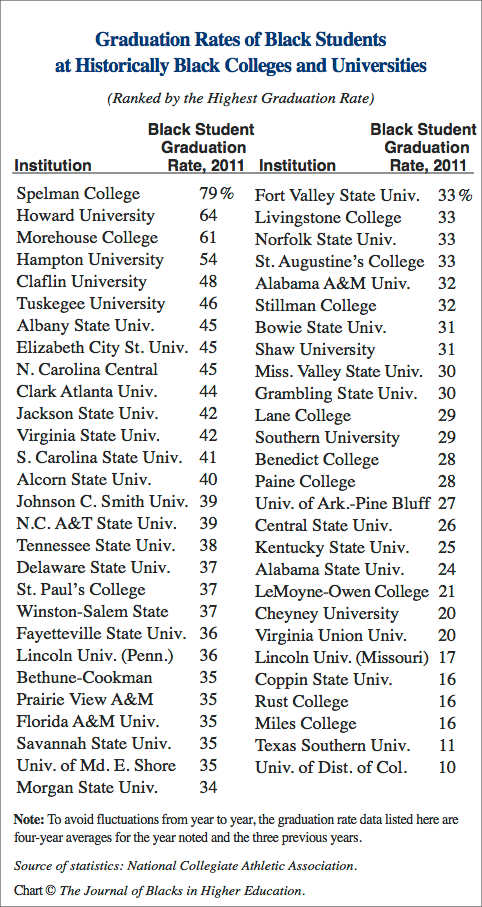
The highest Black student graduation rate at the HBCUs is at Spelman College in Atlanta. There, 79 percent of entering students graduate from Spelman within six years. This rate is higher than the Black student graduation rate at many of the nation’s highest-ranked colleges and universities. The Black student graduation at Spelman College is 15 percentage points higher than at any other HBCU in our survey.
The Black student graduation rate at Howard University is 64 percent. This ranks Howard second among the HBCUs in our survey. Morehouse College in Atlanta ranks third with a Black student graduation rate of 61 percent.
The only other HBCU in our survey with a Black student graduation rate of more than 50 percent is Hampton University in Virginia. There, 54 percent of entering Black students earn a degree at Hampton within six years.
At nearly half the HBCUs in our survey, the Black student graduation rate is 33 percent or lower. At these institutions, less than one third of all entering African American students earned a bachelor’s degree within six years. There are six HBCUs in our survey where less than one in five entering Black students earn a bachelor’s degree within six years.
The lowest Black student graduation rate is at the University of the District of Columbia. There, only 10 percent of entering students earn their degree at UDC within six years. At Texas Southern University in Houston, the Black student graduation rate is 11 percent.
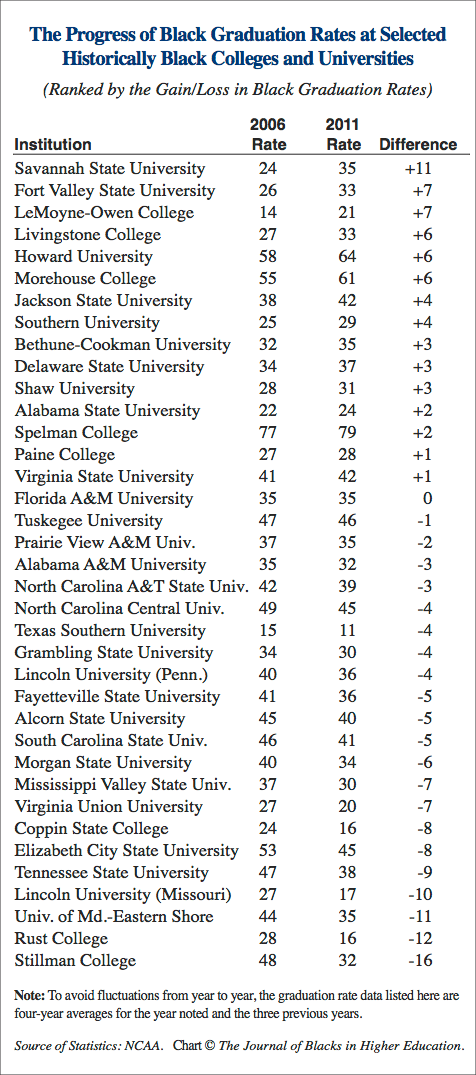
Even more discouraging is the recent trend in graduation rates at historically Black colleges and universities. Of the 37 HBCUs in our survey, 21 have shown a decline in their Black student graduation rate over the past five years. Only 15 HBCUs have shown an improvement. The Black student graduation rate at Florida A&M University is the same as it was five years ago but is significantly less than was the case a decade ago.
It must be noted that the downward trend in Black student graduation rates at HBCUs has occurred during a period of economic difficulty. Many publicly operated HBCUs have seen a decline in state appropriations and cutbacks in state financial aid for college students. Private HBCUs have also faced cutbacks and difficulty in fundraising. This undoubtedly is reflected in lower student graduation rates. Prior research has shown that the major reason that Black students drop out of college is money. Thus, cuts in financial aid programs at HBCUs undoubtedly have contributed significantly to the downward trend in Black student graduation rates at these schools.
There are some bright spots. The graduation rate for Black students at Savannah State University in Georgia has increased by 11 percentage points since 2006. At Morehouse College, Howard University, Livingstone College. Fort Valley State University, and LeMoyne-Owen College, the Black student graduation rate improved by at least 6 percentage points over the past five years.

There are HBCU’s and there are colleges and universities that are predominantly Black and they are not always the same. West Virginia State (though not listed), for example, is an HBCU, but not predominantly Black. UDC is predominantly Black, but not an HBCU. Though the penultimate retention rate is not much better, it is better and belongs to an HBCU. If you are going to do an article about HBCUs you have to be careful to educate the audience about how that is defined and then use the accurate list. Lots of people think that if a school is majority Black, it’s an HBCU. Hopefully this article will generate some scholarly activity to support turning this graduation rate trend around!
Our listing of HBCUs from the Department of Education lists both West Virginia State and the University of the District of Columbia. (While UDC is relatively new, its roots go back far enough to qualify it for HBCU designation.) West Virginia State was not included for the simple reason that the majority of its student body is White. Also, there are dozens of HBCUs that were not included in this study since we are using only those schools where we have been able to track student graduation rates over a long period and this data was not always available for all colleges and universities. In addition, there is a large number of predominantly Black colleges and universities that are not HBCUs. We didn’t include them in this study but may do so in a future post. These predominantly Black colleges, just like HBCUs, are extremely important to African American higher education in this country and efforts to boost graduation rates at both groups are needed.
Indeed you are right and I do apologize. The 1974 founding took it out of the strict “historical” context, but evidently there are exceptions. Thank you for the clarification. I agree with you about not including WVSU. That would not make much sense.
Why would you use the NCAA as the source of graduation rates rather than the official site to which all colleges have to report, NCES?
The NCAA takes NCES data and computes a four-year average. The NCAA also looks at graduation rates for student athletes versus students as a whole. The NCAA data is organized in a way that makes it easy to use and analyze.
But Education Trust is much more reliable and you don’t report the differences in athletes’ graduation and others. I still believe that NCAA data is more unreliable than the sources that use the official reported data of NCES
Why didn’t you include Langston University in your list?
For this post, we only included HBCUs for which we had earlier data so that we could measure progress.
I’m a ’72 graduate of Central State (OH). One important factor men faced at that time was the probability of being drafted into the military if our cumulative GPA dipped below 2.0. In today’s world there are a lot of working parents who stop and start again based on family situations, and also transfers, online degrees, etc. It would not be easy to factor these variables into such a cut and dried survey, but I think current day lifestyles and mobility, along with online education, may provide additional insights.
While the information on graduation rates at HBCUs is very informative, about what percent of Blacks in colleges attend HBCUs. That leaves all the PWCUs with the most students and their graduation rates for Blacks bear watching!
There are several other posts on graduation rates for Black students at PWCUs. Just search “graduation rates.”
Thanks. I have them. I guess the question was rhetorical to emphasize that the majority of Blacks in colleges are in PWCUs and those are the institutions that should receive the same scrutiny from Arne Duncan and his crew that he is suggesting for HBCUs.
I don’t care how you slice the data, it is still a shame. Financial aid plays a huge role in this. Usually students get to college and mess up academically their first year and lose their financial aid. Without financial aid, most blacks cannot go to school.
Not surprised by Spelman, since more black women attend college than black men. And women tend to be more focused in college. And yes I am a black man!
Thank you for publishing information regarding the current status and trends in graduation rates of Black students at HBCUs/predominantly Black institutions. This type of data, though alarming, raises a number of questions and should be the impetus for important discussions surrounding the future preparation, competitiveness, and success of our Black students. As a former chairperson and faculty member at an HBCU, I realized that I needed to be heavily engaged in academic advising, mentorship, and professional development. A good portion of the students who I encountered indicated that they were in college because one or both of their parents told them to go, were not clear on what major they should choose, had changed their major or was considering changing their major, had no clear post-graduation plans, or were working to support themselves, their education, and in some cases, their child(ren). Although these scenarios are not limited to Black students or minority-serving institutions, they could be significant contributors to why we are seeing a decline in graduation rates. Inadequate K-12 preparation, lack of motivation or appreciation for higher education and advanced training, professionalism, and minimal exposure to/knowledge of issues on a local, regional, national, and global level were concerns raised by my faculty colleagues. These too are yet additional factors that could contribute to a decline in graduation rates. With such a multidimensional issue, as academicians, educators, policy makers, and leaders, where do we begin to address this issue? Do we know if an educational disparity exists between graduation rates of Black students at PWCUs versus HBCUs/predominantly Black institutions? Is this observation in graduation rates for Black students only made at our HBCUs/predominantly Black institutions or is the same trend observed for Black students at other institutions of higher education? It is such a joy and a reward to see young Black men and women graduate from institutions of higher learning successfully, and there are tremendous benefits to having additional education. With all of that said, how do we collaborate to improve graduation rates?
Funny you mentioned this. ” A good portion of the students who I encountered indicated that they were in college because one or both of their parents told them to go, were not clear on what major they should choose, had changed their major or was considering changing their major, had no clear post-graduation plans, or were working to support themselves, their education, and in some cases, their child(ren).” I have heard blacks say you should let your children choose their majors. I disagree, I believe Black and black African-American children should be directed into the high demand and high paying fields. Children, like water will travel the road of less resistance. I see Nigerians and other black Africans going into high pay fields in large numbers. I ask why?
The information shown above about Blacks student graduating from any HBCU’s is informative and comprehendable. As I am a black student at a non traditional school or PWCU. I would like to see a study done on Blacks graduation rate at these universities. Is the PWCUs educating us “Blacks” better than the HBCUs? Many would say yes because they have more access to funds so they can better teach the students. Also I would like to see a list of HBCUs offering online degrees for the traditional and nontraditional students. I am entering my last year of my BS program in Psychology. I sit here and wonder what if I could have had the chance to learn online at any HBCU. Would I have taken the chance? The answer would be yes because I would like to experience black education. But since it wasn’t available I had to opt out of that choice and follow another path.
Was Winston Salem State involved in this study?
The latest four-year average graduation rate for Black students at Winston-Salem State University is 37 percent. The university was not in an earlier JBHE study so the university was not included in the table on graduation rate progress. However, after further investigation, it appears that the graduation rate for Black students at the university dropped by 10 percentage points during the period.
What is Xavier’s graduation rate?
According to the Department of Education website, 38 percent of 2004 entering students graduated from Xavier by 2010.
http://nces.ed.gov/collegenavigator/?q=xavier&s=all&id=160904#retgrad
Really! Since when is the NCAA calculating statistics on graduation rates and how were these rates compiled. How and why is an average of three years become a valid indicator of valid and accurate graduation rates trends as indicated in table one. Given the sometimes “questionable” manner in which individual institutions calculate and “report” graduation rates I’m not entirely convinced of the validity of some of these numbers. Those who “know” are not surprisd that Spelman was again at the top. I am however a tad suspicious about of the data “reported” and ultimately “calculated” by a few of the other top schools reflected in table one. Again, since when is the NCAA the barometer. I would strongly urge that graduation rate data be reported based on IPEDS as opposed to the NCAA, unless of course it can be determined with certitude that the NCAA uses IPEDS data to calculate its data. Furthermore, why use an average of four years when a more valid representation of “actual graduation rates is a five year average, (except perhaps in the case of Spelman, Howard or Hampton).
At private Washington University in St Louis (has been called little Harvard) blacks and African students has a higher graduation rate then whites and Asians. Like 96%, why is this not widely known?
Actually using the same data set used in this article, the Black graduation rate at Washington University is 90 percent whereas the White rate is 94 percent. These graduation rate figures at high ranking universities are regularly reported by JBHE.
This number for students entering in 2004 is inaccurate and low because Hurricane Katrina happened in 2005. Many students transferred due to this reason. XU’s graduation rate has been reported between 55-56%. Considering we have a 6 year pharmacy program that many students enter also decreases our graduation rate. Yes, I am a proud alum. I attend a PWU for undergrad where almost no one graduated on time. When I attended Xavier I was shocked at how students graduated on time and continued on to pharmacy , medical or graduate school. Great university!
What was the graduation rate for Fisk University?
According to the U.S. Department of Education, for the class that entered Fisk in the fall of 2004, 59 percent earned their bachelor’s degree at Fisk by 2010.
If you look at the percentage or numbers of us who attend HBCUs versus PWC and compare graduation rates, I think the results lean in favor of HBCUs. Ex: at one time, the top five schools sending Black kids to Med/Dental school were: Xavier (Nawlins), Spelman, Morehouse, Hampton and Howard. Note the absence of the Ivys and the HBCUs are also still known for taking that diamond in the rough student, cutting, polishing and making it shine! Most PWCs will not even minimally consider that same kid.
I taught for several years at Winston Salem State University. I conducted my dissertation research in the archives at Fisk and Atlanta University (Clark/Morehouse) respectively. Currently I am on the faculty at Syracuse University and I am African American. I agree that financial aid is a major contributing factor to the drop out rates listed above but I am also critical of the lack of faculty mentorship in our HBCUs. I know of countless progressive scholars (myself included) who were literally driven out for their diligence and their vision. I am not speaking about all faculty at HBCUs but I witnessed administrators and faculty working at 1/4 speed, bitter staff and mistreated students. At WSSU most people seemed to feel under-appreciated and this culture impacted everyone especially the students. I know this changes the tone of the above thread but after completing my PHD and accepting a position at WSSU, my mentors who left places like Morgan State and Howard for jobs at NYU or Penn State, told me “It is a steppingstone, get your publications out and get out!” But I was so excited to work with young African American students. I was quickly disillusioned and all but asked to leave despite stellar course development, scholarly publications and community service. In the HBCU system i saw three kinds of faculty: those who were complacent with mediocrity, Black senior scholars who left more demanding appointments for a “semi-retirement” in the HBCU system where the expectations are low and the accountability was non-existent or those of us who hoped to invigorate our institution and students with the zeal, racial pride and diligence that graced our campuses in the early 20th century. Sadly the later are few.
wvsu was founded as west virginia collgiate institute and prior west virgina colored institute my greatgrandfather was a co-founder…a more accurate view of graduation rates would be to look at a 5 year period as opposed to 4…many college graduates take 5 years
These figures are for students who earned their degrees within six years, not four or five.
How do the graduation rates of African American students compare at predominately white institutions? While these rates are low for many HBCUs and must be improved, are the chances greater for African American students to graduate from PWIs?
Depends on the college or university. Some have very high graduation rates and others are very low. The data for any college or university is available through the Department of Education’s College Navigator website.
The best way to look at HBCUs is not to compare them to PWIs because 80% of the Black undergraduate students are enrolled in PWIs. Although the USDE says that HBCUs must do better, they must make clear the non-cognitive advantages they provide to Black students, if they do and look for ways to measure that as well as graduation rates. In the Illinois public PWIs the 6 year graduation rates for Black students range from 9% to 71% . In the private-not-for profit institutions in Illinois that enroll the largest number of Black students, the 6-year graduation rates range from 5% to 88%. You can probably tell which institutions have the largest graduation rates (the ones with the highest test scores). The same is true of HBCUs.
We agree. That is why this post simply compared the graduation rates at HBCUs. For students choosing a college, it is important to see which HBCUs are graduating a large percentage of their students and which are making progress compared to their rates several years ago.
Black student graduation rates are also impacted by which schools have the money to offer financial aid. Many Black students leave college not because they are failing academically, but because they cannot afford the expenses and federal and state aid is insufficient to meet their needs.
I am curious why these institutions were chosen to be featured? My institution is not present on the list and I am aware of several other institutions that are not listed as well.
We only featured HBCUs for which we had earlier data so that we could measure progress.
Black student graduation rates as a whole are not great whether it’s an HBCU or PWCU. Articles that ask “what’s going on at HBCU’s” total miss the larger issue. It’s not the schools…HB or PW. It’s the culture of anti-intellectualism that exists in our communities (which is a product of our own making). We have to make education an inherent priority in our communities. Poverty can’t continue to be our excuse because there are many, many poor immigrant communities in the US where the parents are spending the majority of their income on education. A good example is ChinaTown here in Chicago. It is NOT an affluent community by any means but education is paramount and that is reflected in their academic success. Same goes for African immigrants to the U.S. They are represented in ABUNDANCE in the fields of medicine, pharmacy, and nursing. Those statistics we are reading about the booming number of blacks in college are enhanced not by American born blacks but by Africans.
My close friend recruits in Chicago high schools for students to attend vocational schools (and she has been to all of them in Chicago multiple times over the years). The career field for the majority of the girls she encounters in CPS? They want to “do hair”. The boys? Well they say “they want to play ball” ( she says she rarely hears kids say they want to be rappers. Myth busted!). WHEN she can get the parents to participate she says it takes all of her reserve to not roll her eyes at the moms who say, “how much all that cost” while sporting $150 yakki and designer purses. And that’s only IF parents participate. Most often they don’t. If the support structure is failing kids before they go out of the door then how can we expect them to succeed regardless of the type of school? I know a lot of the kids will be 1st generation in college so as a community we need to find a way to offer support and mentoring if the family is unable. Not trying to knock churches but they are full of single mothers who need help. Can we cut out two “women’s board” meetings or choir rehearsals and get some mentoring done? Just asking because in Chicago it is NOT being done (although there certainly a lot of grants being given to some of these churches to do just that).
Would you publish the number of annual graduates from the Howard University’s graduate schools?
I would contact the university directly for this information.