















 |
|
 |
|
|
|
| JBHE’s Annual Citation Rankings of Black Scholars in the Social Sciences and the Humanities For the fourteenth consecutive year, JBHE publishes its citation rankings of black scholars in the social sciences. Once again, as has been the case in each of our previous surveys, the black scholar with the highest citation count in social science journals is Harvard’s University Professor William Julius Wilson. But David R. Williams of the Harvard School of Public Health and Claude Steele of Stanford University are closing the gap. This year they finished just behind Professor Wilson. In the humanities rankings, Yale’s Paul Gilroy is the most cited scholar for the third time in four years. This year Professor Gilroy led by a large margin. The well-established though controversial practice of citation analysis is based on the premise that it is possible to measure the impact of a scholar, an academic department, or even an entire university by the number of times scholarly research papers are cited by academic peers. In this way, proponents of citation analysis contend, it is possible to rank the world’s physicists, chemists, or even black studies scholars by the number of citations their works generate in the research papers of their academic peers. In our current “publish or perish” academic world, the citation-analysis technique, although not as positively regarded as it was several years ago, is still used by deans and department heads as a tool to help them make decisions on academic promotions, compensation changes, and tenure votes. Also, academic institutions and departments commonly broadcast favorable citation rankings of their faculties in appeals for alumni gifts and foundation grants. William Julius Wilson Leads Once Again
But in 2007 the social science citation competition among black scholars was the closest it has been since JBHE began conducting the count 14 years ago. It now appears that Professor Wilson has some serious challengers. David R. Williams, former Harold W. Cruse Collegiate Professor of Sociology and a professor of epidemiology in the School of Public Health at the University of Michigan and now Norman Professor of Public Health at the Harvard School of Public Health, has ranked just behind Professor Wilson in each of the past three years. Dr. Williams has conducted groundbreaking research on the determining factors producing racial disparities in healthcare. Williams had 274 citations in this year’s count, which placed him in a tie for second among black scholars in the social sciences. With racial disparities in healthcare becoming a major social issue, the scholarly work of Professor Williams may challenge Professor Wilson’s perpetual leadership in social science citation rankings in the years ahead.
Princeton University professor Cornel West, one of the nation’s so-called marquee scholars, is in fourth place in the current rankings, the same position he held a year ago. Professor West had 220 citations in 2007, one more than his total in 2006. This year the highest-ranking black woman in the social sciences citation index was Vonnie McLoyd, professor of development psychology at the University of Michigan. She had 163 citations in 2006, which placed her in fifth position overall. Professor McLoyd had 10 fewer citations in 2007 than she did in 2006, but she still moved up one place in our rankings. Her research focuses on the impact of economic hardship on family processes, children’s mental health, and beliefs about personal efficacy. Elijah Anderson, a professor of sociology formerly at the University of Pennsylvania and now at Yale (See article on page 68 of this issue of JBHE), holds the sixth spot in our rankings, down one position from last year’s rankings. Professor Anderson continues to receive citations for his critically acclaimed 1999 book, Code of the Street: Decency, Violence, and the Moral of Life of the Inner City, as well as for his book, A Place on the Corner: A Study of Black Street Corner Men. An updated second edition of this work was published in 2004. Paul Gilroy, formerly of Yale University, now holds the Anthony Giddens Professorship in Social Theory at the London School of Economics. He placed seventh overall in our social science citation count. Professor Gilroy had 143 citations, up 15 from a year ago. The only other black scholar to receive 100 or more citations in the social sciences was Lawrence Bobo, the noted sociologist who a few years ago left Harvard University for Stanford University and has now returned to Harvard. Professor Bobo ranked eighth in this year’s survey with 142 citations, an increase of 30 from a year ago. This was the largest increase recorded in our count. Most Cited Black Scholars in the Humanities
In JBHE’s first four annual surveys of citations in the arts and humanities (1998-2001), the highly prolific and influential black scholar Henry Louis Gates Jr. of Harvard University led our rankings. In 2002 Paul Gilroy, who recently left Yale for the London School of Economics, was the leader in the citation count in the humanities. Toni Morrison, the Nobel laureate and Princeton University professor, led the rankings in 2003. In 2004 these three scholars were once again at the head of the rankings. Professor Gilroy held the top spot with 112 citations, followed closely by Professor Gates. In 2005 Professor Gates narrowly edged out Professor Gilroy with Professor Morrison not far behind. In 2006 and again this year Professor Gilroy is ranked first. He had 140 citations in humanities journals in 2007, an increase of 35 from 2006. Unlike previous years when Professors Gates, Morrison, and Gilroy ran neck and neck, this year Professor Gilroy led the rankings by a huge margin. Henry Louis Gates Jr. finished in second place with 85 citations, down from 113 in 2005, but up slightly from a year ago. Paule Marshall, New York University professor and author of Brown Girl, Brownstones and many other books, moved from eighth place last year to third place this year. Her citation count increased from 51 in 2006 to 79 this year. Toni Morrison’s citations decreased from 100 in 2006 to 75 in 2007, placing her in fourth place. Novelist Alice Walker had 64 citations in 2007, placing her in fifth position in our survey. Poet bell hooks had 61 citations in humanities journals in 2007, up three from a year ago. This puts her in sixth place in our survey, one position lower than last year. Also among the most highly cited black scholars in the humanities are Princeton’s Cornel West; literary critic and novelist Albert Murray; Colin Palmer, Dodge Professor of History at Princeton University; Danielle Allen, former University of Chicago scholar, now at the Institute for Advanced Studies in Princeton, New Jersey; author Chinua Achebe, who teaches at Bard College; and Houston A. Baker, who left Duke University two years ago for Vanderbilt University. |
|
|
|

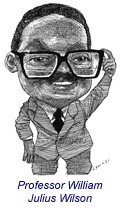 As we have done since 1993, JBHE recently conducted a database search of Thomson Scientific’s Social and Behavioral Sciences Index for the citation counts of dozens of black scholars in this discipline. In each of the past 13 surveys JBHE conducted on black scholars in the social sciences, we determined that the leader in rankings was Professor William Julius Wilson, the sociologist formerly at the University of Chicago who now is University Professor at Harvard University. The results this year are unchanged. Once more, the citation count leader is Professor Wilson with a total of 281 citations in academic journals. Professor Wilson’s citation count decreased by 22 from the previous year’s count.
 Claude M. Steele, a professor of psychology at Stanford University, finished in a tie with Professor Williams for second place this year with 274 citations. Professor Steele continues to receive widespread notice for his work on so-called stereotype vulnerability confronting black students when they take standardized tests.
 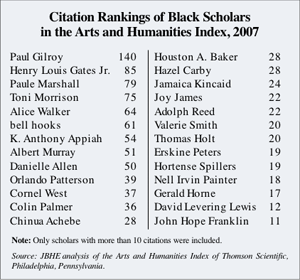 But what about black scholars in the arts and humanities? Academic journals play a less important role in the humanities in comparison to the natural sciences or even the social sciences. There are not a large number of journals in which humanities issues are routinely debated. Therefore, the number of citations given to a particular scholar in the humanities — even some of the most highly respected novelists, poets, and playwrights — are likely to be far below the number of citations assigned to a scientist who publishes just one important paper in a scientific journal.