
















 |
|
 |
|
|
|
| Harvard President Drew Faust Pledges a Major Increase in the Number of Black Faculty Harvard President Drew Faust recently promised a major increase in the number of black faculty at Harvard. Her ambitious plan is a breath of fresh air after the five-year presidency of Lawrence Summers, who had little interest in bringing greater racial diversity to Harvard. At Harvard, as elsewhere, hiring decisions are made at the departmental level. Therefore, it is unclear how President Faust will achieve her goal. It was clear from the day of his inauguration that former Harvard president Lawrence Summers had no interest in increasing the racial diversity of the faculty at Harvard University. Almost immediately upon taking office, Summers signaled an unfriendly policy on race by immediately announcing that Harvard’s black studies program would no longer have “a blank check” to pursue its mission. Later, Summers greatly weakened the African and African-American studies department by triggering an unnecessary feud with Cornel West, which led to the departure to Princeton University of both West and Professor K. Anthony Appiah. Both were serious losses to Harvard.
Summers’ later speculation, that the absence of women faculty in the sciences and mathematics might be due to inherent genetic differences, finally ended his presidency. His suggestion of the possibility that there might be an inherent inferior intelligence in certain groups led many black academics to conclude that Summers probably held similar views about the inherent capabilities of African Americans. One tenured professor at Harvard told JBHE at that time, “It is readily apparent to those of us at Harvard that Larry Summers actually believes that women and minorities are less capable than white men.” Harvey C. Mansfield, Thomson Professor of Government at Harvard University, always a loyal defender of Summers, correctly stated that Summers “transformed the policy of affirmative action by reducing the pressure to hire more blacks and women.”
At a recent reception on the Harvard campus held for the Association of Black Faculty, Administrators, and Fellows, Faust called for the creation of “a different Harvard,” one with far greater numbers of black faculty members. Speaking of the scope of the African-American hirings that she planned, Faust said, “One of our goals is, maybe three years from now, we can’t have this party here anymore,” Faust said. “It’s going to be so big. First, we’re going to move up to Annenberg. Next, we’re going to have to go to the stadium.” President Faust’s call for a “different Harvard,” which is committed to a much larger number of black faculty, reflects a decision to deal head-on with Harvard’s unfavorable ranking in black academia. The data, which we report here, shows that Harvard is seriously behind other peer institutions in its percentage of black faculty and has a long way to go to reach its goals. A recent report by Evelynn M. Hammonds, senior vice provost for faculty development and diversity at Harvard, identified 46 blacks among the nonmedical tenured or tenure-track faculty at Harvard University. They made up 3.5 percent of the total nonmedical faculty with tenure or on the tenure track. There are 27 blacks who hold tenure at Harvard. They make up 3.2 percent of all tenured nonmedical faculty.** Elsewhere in leading U.S. universities, there have been superior gains. JBHE’s latest count shows that blacks are 6.2 percent of the arts and sciences faculty at Duke University. Blacks are 5 percent or more of the total full-time faculty at Columbia, Emory, Chapel Hill, and the University of Michigan. Dartmouth College, located in rural New Hampshire far away from urban environments where large numbers of blacks prefer to teach, has a higher percentage of blacks on its faculty than does Harvard University. In contrast, Princeton, Yale, MIT, Berkeley, and the University of Pennsylvania appear to have black faculty levels very similar to that prevailing at Harvard.
More than one half of the nonmedical black faculty at Harvard hold posts in the university’s professional schools of law, business, divinity, and education. Six of the 80 faculty members at Harvard Law School, or 7.5 percent, are black. There are five black professors each at the Harvard Business School and the Harvard School of Public Health. Blacks make up more than 8 percent of the total faculty in the Graduate School of Education and Harvard Divinity School. There are no black faculty members at the Harvard School of Dental Medicine or the Graduate School of Design. Since faculty hiring decisions are made primarily at the departmental level, it is unclear how President Faust will achieve her goal of significantly increasing the number of black faculty at Harvard. In scholarly prestige, Harvard ranks at the top of the world. Many of its faculty divide the world into two groups — those who are qualified to teach at Harvard and those who are not. Accordingly, a solid view persists that there are few African Americans with the sufficient academic prowess to teach at Harvard. This is a stone wall that President Faust will face. Henry Louis Gates Jr., Alphonse Fletcher University Professor and director of the W.E.B. Du Bois Institute for African and African American Research at Harvard, told JBHE, "We just don’t know yet. She has not announced the plan."
*Professors Morgan and Bobo will now return to Harvard in January 2008. Both will hold tenured faculty positions. Henry Louis Gates Jr., Fletcher University Professor and director of the W.E.B. Du Bois Center for African and African-American Research at Harvard, gleefully told JBHE, “The ‘Dream Team’ is back.” **Medical school faculty are excluded because their inclusion distorts the overall data. There are nearly 7,000 people who are listed as faculty members of the Harvard Medical School. Many of these are physicians who do not teach in the classroom but are members of the staff of teaching hospitals or other medical facilities affiliated with the university. There are 148 blacks among the 6,989 faculty members of the Harvard Medical School. They are 2.1 percent of the total medical school faculty. There are three blacks among the 653 faculty members who hold tenure at Harvard Medical School. |
|
|
|

 Late in his presidency, Summers denied tenure to Marcyliena Morgan after the African and African-American studies department, then chaired by the eminent black scholar Henry Louis Gates Jr., had unanimously recommended that tenure be awarded. This decision drove both Morgan and her husband, the esteemed sociologist Lawrence Bobo, to Stanford University.* Apparently Summers never informed himself that Professor Bobo was not only an important scholar but also that he was in line to head the African and African-American studies department when Professor Gates stepped down.
 When Drew Faust, an honored historian of the South, was appointed president of Harvard last winter, black scholars and others in academia interested in the progress of blacks in higher education expressed cautious optimism that President Faust would breathe new life into black studies at Harvard. It was believed as well that she would push for greater racial diversity in the student body and faculty. Now it is clear that these expectations were justified.
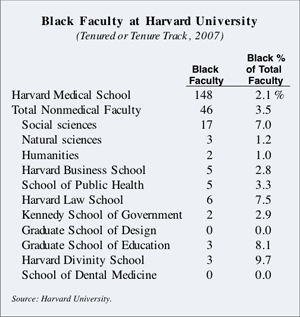 There are some fields at Harvard where blacks are well represented in faculty positions and others where blacks have no presence. There are 17 blacks among the 242 tenured or tenure-track faculty in the social sciences. Therefore, they make up 7 percent of the total social science faculty. A large number of these teach in the department of African and African-American studies. In contrast, there are only three blacks among the 242 faculty in the natural sciences at Harvard. There are only two blacks among the 208 tenured or tenure-track faculty in the humanities.